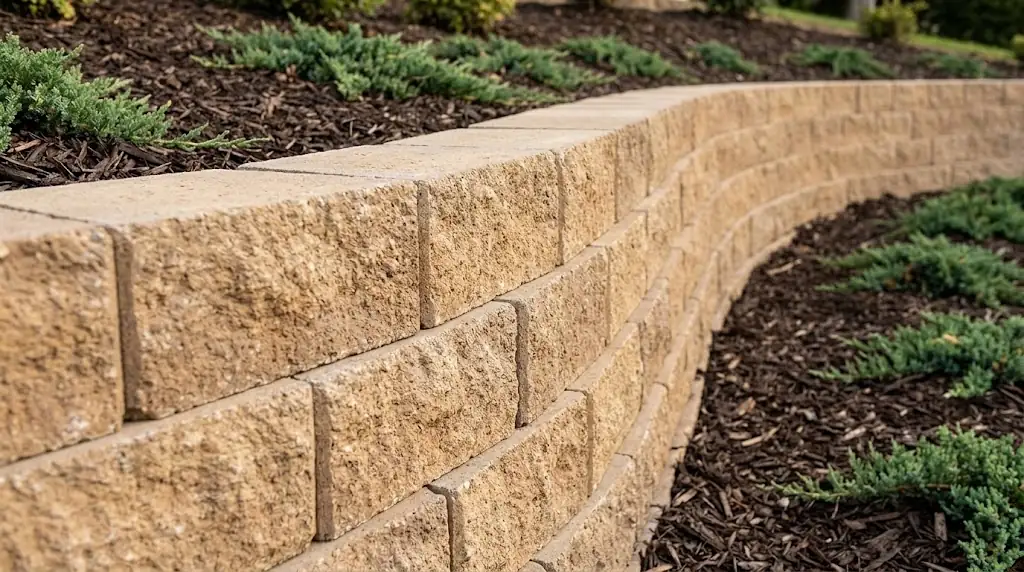
North Alabama’s rolling terrain makes a well-built retaining wall one of the most valuable hardscape investments a homeowner can make. Huntsville Pavers designs and installs custom retaining walls throughout Huntsville, AL, helping homeowners manage sloped yards, prevent erosion, and reclaim usable outdoor space that would otherwise be lost to a hillside.
Solving Huntsville’s Sloped-Yard Problem
Between the foothills around Monte Sano, the rolling terrain near Hampton Cove, and the gentle grade changes found throughout many established and newer neighborhoods alike, a lot of Huntsville properties deal with some degree of slope. A sloped yard isn’t just an inconvenience — over time, it can lead to real problems: soil erosion during heavy spring rains, water pooling near your foundation, and unusable sections of yard that are too steep to mow, plant, or walk on comfortably. A properly engineered retaining wall breaks a slope into level, usable sections, stops soil from washing away, and can turn a wasted hillside into a terraced garden, a flat play area, or an expanded patio footprint.
Built to Handle Real Soil Pressure
Retaining walls carry a job that other hardscape features don’t: they hold back the lateral pressure of soil, and sometimes water, behind them full-time. This is exactly where under-built walls fail. A retaining wall that isn’t engineered with proper base depth, backfill, and drainage will eventually bow, lean, or collapse — and in North Alabama’s clay-heavy soil, which absorbs and holds water more than sandier soils do, that added hydrostatic pressure makes proper engineering even more important. Every wall we build starts with a compacted gravel base set below the frost line and extends backward with the appropriate embedment depth for the wall’s height, so it’s built to actually do the job it’s there for, not just look the part.
Drainage Is the Difference Between a Wall That Lasts and One That Fails
The single biggest cause of retaining wall failure isn’t the wall itself — it’s water. When water builds up behind a wall with no way to escape, the added hydrostatic pressure pushes the wall forward over time, regardless of how well it was initially built. That’s why every retaining wall we install includes a properly installed drainage system: a perforated drain pipe at the base of the wall, a layer of clean gravel backfill behind the wall face, and, where needed, a fabric barrier to keep fine soil particles from clogging the drainage gravel over time. Given how much rain North Alabama sees in late winter and early spring, this isn’t an optional upgrade — it’s a core part of building a wall that will still be standing straight in twenty years.
Retaining Walls for Every Purpose
Retaining walls serve a range of purposes beyond basic erosion control, and we design each one around what you actually need it to do:
- Terracing a sloped backyard into level sections for lawn space, gardens, or additional patio area
- Creating raised planting beds with a defined, structural edge instead of a loose slope
- Protecting a driveway or foundation from soil erosion and runoff on a sloped lot
- Adding seat walls that double as extra seating around a patio or fire pit while also managing a grade change
- Framing a paver patio or pool deck built into a hillside, giving you a level surface where one didn’t exist before
Material and Design Options
We work with a range of retaining wall systems, from interlocking concrete block walls to natural-stone-look segmental units, so the finished wall complements the rest of your property rather than looking like a purely functional add-on. Wall height, batter (the slight backward lean built into taller walls for stability), and cap style are all things we walk through with you during the design phase. For walls beyond a certain height, we also factor in engineering requirements specific to the load and site conditions, since taller retaining walls carry significantly more pressure than a low garden wall.
Our Retaining Wall Installation Process
- Site assessment — We evaluate the slope, soil conditions, and drainage patterns on your property to determine the wall height, length, and design that will actually solve the problem.
- Excavation — We excavate a trench below the frost line to the depth required for the wall’s height and soil conditions.
- Base installation — A compacted gravel base is laid and leveled to provide a stable foundation for the first course of blocks.
- Wall construction — Blocks are set course by course, with proper backward batter and structural reinforcement as needed for taller walls.
- Drainage installation — A perforated drain pipe and clean gravel backfill are installed behind the wall to manage water pressure long-term.
- Backfill and finishing — The area behind the wall is backfilled, compacted, and graded, with a cap installed along the top course for a finished look.
Get Your Retaining Wall Built Right
A retaining wall is a permanent structural feature, and it’s not the place to cut corners on base depth or drainage. Huntsville Pavers builds retaining walls engineered for Huntsville, AL‘s clay soil and rainfall patterns, so your wall holds up the way it’s supposed to for decades. Contact us through our contact page for a free consultation and quote.